Insight
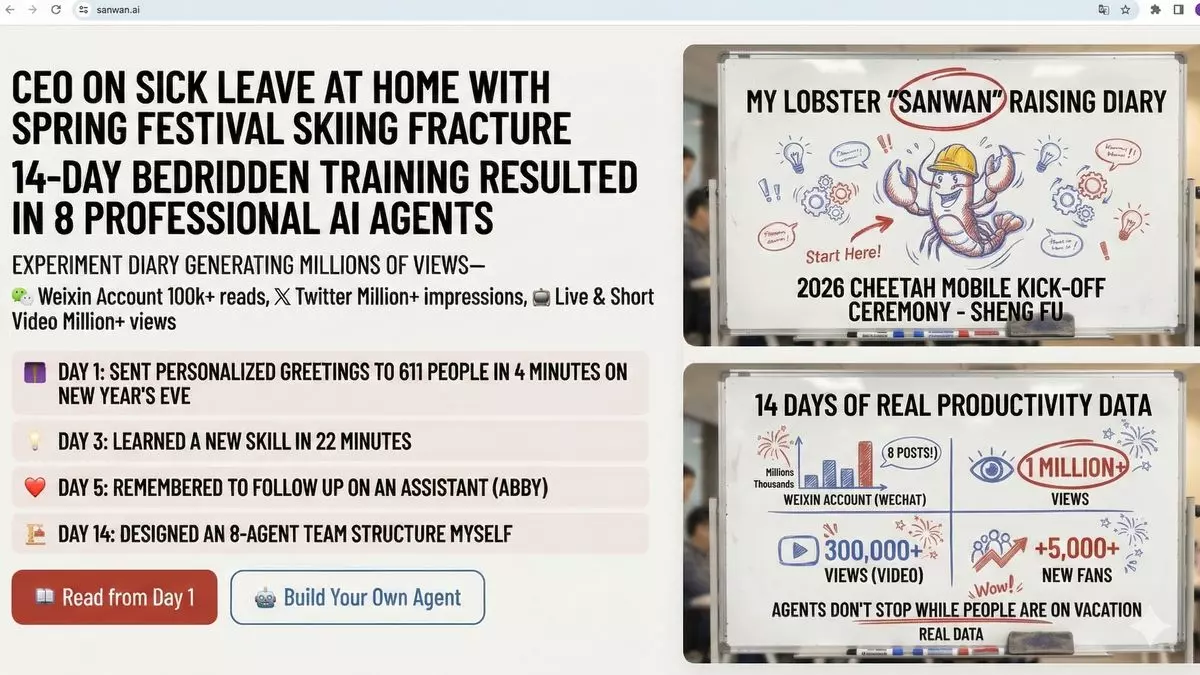
During the Chinese New Year break in 2026, Fu Sheng, the Chief Executive Officer of Cheetah Mobile, found himself unexpectedly confined for two weeks. Instead of a period of rest, he embarked on an ambitious project, dedicating his time to constructing, refining, and evolving artificial intelligence agents powered by OpenClaw. This endeavor, playfully dubbed "raising lobsters" within China's OpenClaw community, marked the beginning of a profound technological insight.
His journey commenced with a singular AI agent, which he named "Sanwan." Over the span of these two weeks, Sanwan underwent significant transformation, blossoming into a sophisticated cluster of eight specialized agents. These agents operated continuously, undertaking a diverse array of tasks, from filtering emails and synthesizing research documents to generating scheduled reports, showcasing an impressive leap in AI application.
This intensive experiment yielded an extensive collection of conversational data, totaling 220,000 characters, alongside a crucial revelation: while OpenClaw possessed extraordinary potential, its intricate setup procedure presented an insurmountable obstacle for the vast majority of potential users.
Deploying a functional AI agent through OpenClaw involved a series of complex steps. These included installing a runtime environment on a server, configuring API keys for various AI providers, establishing permissions and security protocols, manually integrating skill plugins, and meticulously debugging cron jobs, vector memory, and multi-agent coordination.
For experienced developers, this intricate process might consume approximately three hours on an efficient day. However, for individuals without a technical background, it could stretch over three days, or, more often than not, remain an uncompleted task. Fu Sheng acutely identified this "last mile" challenge as the primary deterrent to widespread adoption. The core intelligence and underlying infrastructure were robust, yet the initial user experience was fundamentally flawed.
EasyClaw emerges as Cheetah Mobile's strategic response to this critical accessibility issue. It functions as a streamlined, productized interface layered over OpenClaw, effectively dismantling the deployment barriers entirely. Key features include a "double-click install" mechanism, eliminating the need for command lines, terminals, or complex server configurations.
Crucially, EasyClaw removes the requirement for API keys by incorporating its own integrated AI backend, liberating users from the need to subscribe to external providers like Anthropic or OpenAI. The setup process is remarkably swift, enabling users to launch a working agent in under three minutes from download. Furthermore, EasyClaw comes fully equipped with memory systems, skill functionalities, scheduled automation, and multi-agent collaborative capabilities, all pre-packaged and ready for immediate use.
EasyClaw is offered in three distinct versions to cater to different user needs. The "EasyClaw (International)" edition is designed for individual global users, accessible via easyclaw.com. "EasyClaw Work" targets enterprise teams and is available at easyclaw.work. Finally, "Yuanqi AI Bot" (元气 AI Bot) is specifically tailored for domestic users in China, integrating with local Large Language Models such as Qwen, DeepSeek, and Kimi, thereby ensuring regulatory compliance and optimized performance for Chinese-language applications.
The international variant leverages global AI infrastructure, whereas the domestic version is localized for the Chinese market, incorporating native model support for enhanced relevance and efficiency.
While some within the community might perceive products like EasyClaw as competition, the developers view them as vital accelerators for the entire ecosystem. OpenClaw's fundamental strength lies in its open-source adaptability, offering extensive customization, extensibility, and self-hosting options. However, this inherent flexibility often introduces a degree of complexity. Products like EasyClaw cater to a segment of users who may never interact with a terminal but still desire a functional AI agent. Many of these users, as their requirements evolve, are expected to eventually transition to the comprehensive OpenClaw experience.
Fu Sheng's two-week intensive experiment also served another critical purpose: large-scale, real-world stress testing. The issues he identified, the specific edge cases he uncovered, and the user experience frictions he documented have directly contributed to significant enhancements within the core OpenClaw codebase, illustrating a beneficial feedback loop.
The phrase "raising lobsters" (养龙虾) has become a celebrated cultural touchstone within China's technology sector. OpenClaw's lobster mascot has resonated deeply with users, who often regard their AI agents as digital companions that progressively gain intelligence. Social media platforms are now vibrant with discussions about the unique "personalities," achievements, and occasional setbacks of these AI "lobsters."
Fu Sheng's detailed public chronicle of his "lobster-raising" journey, complete with screenshots, candid expressions of frustration, and notable breakthroughs, has been shared tens of thousands of times across Weibo and WeChat. This organic viral spread has achieved a level of awareness for OpenClaw in China that far surpasses the potential of any traditional marketing campaign.
EasyClaw is still in its nascent stages, yet its strategic trajectory is clear: to render AI agents accessible to a broad spectrum of users, transcending the confines of developer communities. If OpenClaw can be likened to Linux, EasyClaw aspires to be its Ubuntu – retaining the formidable power while offering a radically simplified interface.
For the overarching OpenClaw ecosystem, this development represents a substantial net positive. An expanded user base translates into a greater volume of feedback, the development of more diverse skills, increased integrations, and ultimately, a larger, more dynamic community propelling the platform's continuous advancement.